 1 / 6
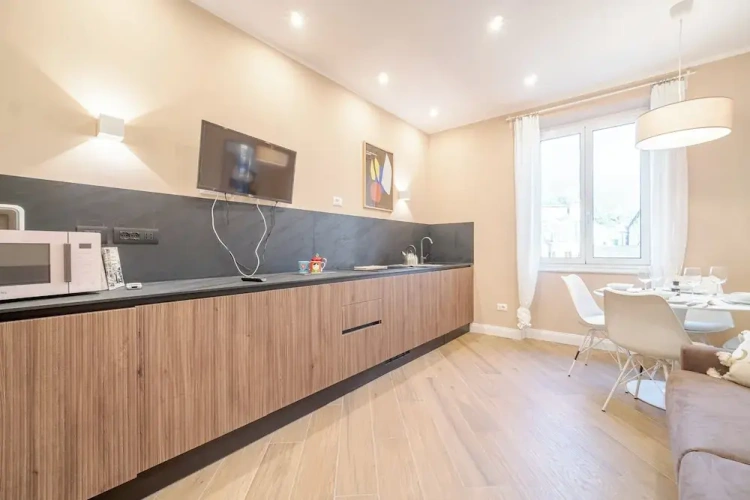
1 / 6 Premium Apartment
- Private bathroom
- kitchen
- microwave
- private-bathroom
- washing-machine
What's the price for your stay?
Add your dates to see current rates.

Room Information
1 / 6 Add your dates to see current rates.
Recent reviews shared by hotel guests
Entry to the Basilica is free, and it’s open every day. Santa Maria delle Vigne is considered Genoa’s oldest Marian sanctuary. The name means “of the vines,” since vineyards surrounded the church before the area was developed. It stands in the Maddalena district, in the old town, near other major monuments. Piazza delle Vigne, lined with noble palaces, is dominated by the basilica’s façade. The church remains a parish and an important place of Marian devotion, with the feast of the Presentation of Mary on November 21 celebrated here with particular significance. A chapel dedicated to the Blessed Virgin Mary had stood on this site since the 6th century. Tradition says it was built in response to a Marian apparition. Around 980, at the end of the 10th century, Oberto Visconti and Guido di Carmandino began building a new church there. Its first documented mention is in the Registrum Curiae of 1083. It became a parish church in 1147 and played an important part in religious life in the port-side commercial district. The original church had a typical Romanesque layout, with three naves, a transept, and an apse, along with strong walls and a simple plan. Its most distinctive surviving Romanesque feature is the tall bell tower, with bifora and pentaphorae, or two- and five-light windows. At the top is an octagonal turret, or cuspide, with sharp pinnacoli around it. The building was altered many times from the 13th century onward. In the late 16th century, the Grillo family funded major work to modernize and enlarge the apse and side chapels. During the 17th century, the interior was reshaped in the Baroque style, with contributions including Daniele Casella. A dome, new columns, decorations, larger windows such as semicircular ones, and redesigned vaults and side chapels were added. The façade, designed by Ippolito Cremona, was built in the Neoclassical style between 1841 and 1848. In 1983, Pope John Paul II gave the church the title of minor basilica. Inside, the main altar by Giacomo Antonio Ponsonelli, dating to 1730, has a statue of the Virgin Mary supported by angels. Among the side altar paintings are the Natività della Vergine by Giuseppe Cades, the Presentation of the Virgin by Giovanni David, and the Annunciazione by Carlo Giuseppe Ratti. The 15th-century side portal has sculptures attributed to Donato Rodari and Giovanni Gaggini. Above it, a lunette holds a fresco by Domenico Piola of the Madonna and Child with San Giovannino holding a bunch of grapes. Under an arch at the base of the bell tower is the tomb of Anselmo d'Incis, a papal physician, who died in 1304. It is topped by the front of a 2nd-century Roman sarcophagus depicting “The Death of Phaedra.”
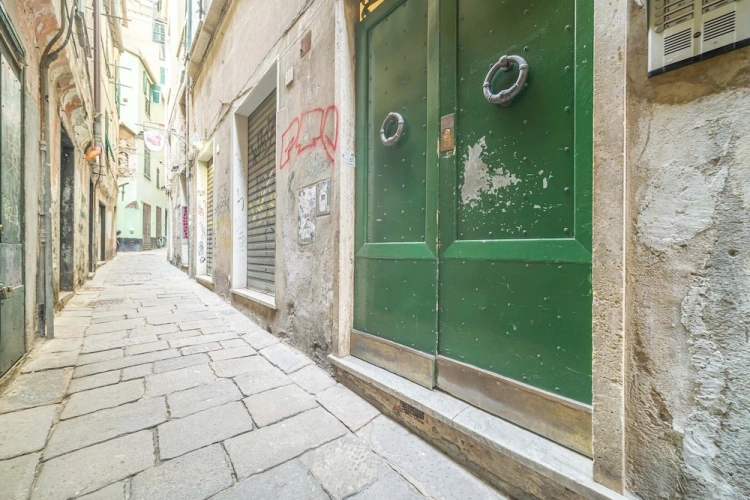
Finding your way through Genoa’s oldest quarter can be tricky, with narrow alleys, or “caruggi,” winding through it. In the basilica, the 17th-century Chapel of Santa Maria delle Vigne, in the right aisle, is one of the most beautiful in Genoa, Italy.
The outside gave me no hint of what was waiting inside. We ducked through a little doorway in a lane to get out of the rain, and the interior took us by surprise. It may be one of the most beautiful churches I’ve ever seen. The ceiling’s detailed paintings and gold work are exquisite, and a large magnifying mirror near the entrance lets you inspect it closely. The marble, stonework, and paintings by the remarkable artisans of the past are breathtaking. Highly recommended.
Right in the center of Genova, and a spectacular church.
The façade might not catch everyone’s eye, but step inside and see for yourself what a magnificent church this is.
Explore attractions, restaurants and transport around the hotel
239 m 3 min walk
292 m 4 min walk
130 m 2 min walk
21 m 1 min walk

Important conditions for your stay