Featured review
Katherine Y.
10/10
A lovely old church tucked into the Oltrarno neighborhood. It's a peaceful place to pray.

Recent reviews shared by hotel guests
A lovely old church tucked into the Oltrarno neighborhood. It's a peaceful place to pray.
The church's displays stayed with me as much as its art. At the entrance, I saw information about a documentary on Russian opposition leader Alexei Navalny, including his message before his assassination: "My message is very simple: Don't give up. If you decide to kill me, it means we are demonstrating power beyond imagination. The only necessary condition for evil to triumph is for good people to stand idly by. So, please do not do nothing." Why put this statement here, especially the warning about evil triumphing? Above it was an article from the Italian newspaper *Il Foglio*, dated May 8, 2020, when the global COVID-19 pandemic and government restrictions on religious gatherings were at their height. Its headline said, "Mass is not a show" (La messa non è uno show). The display said authorities could legally ask for church gatherings to pause temporarily, but had no right to judge how urgent worship was. Masses were being broadcast live, yet believers saw them as communion with the divine, not a performance. To me, the pairing of these displays suggested a strong position: the church saw interference with the essence of faith as oppression, and chose not to stand by. Inside, the Basilica of San Felice in Piazza holds Giotto's (1267-1337) *Crocifisso di San Felice*, painted in the early 14th century. Giotto was a Renaissance pioneer, and this late work came after his return to Florence and the fame he had gained. He no longer had anything to prove; his technique was more restrained, with light working in a unified, natural way. Compared with his earlier work on the same subject at the Basilica of Santa Maria Novella, this painting feels more developed and delicate. Jesus' softly shaded muscles look warm and three-dimensional, while the shadows make the direction of light clearer. His calm pose and deep-set features sit alongside arms visibly taut under his body's weight. These are human figures shaped by gravity. That lifelike treatment deeply moved believers at the time and showed an emerging humanism. The Basilica of San Felice in Piazza, built in the 11th century, is among Florence's oldest buildings. From Giotto to Michelangelo, the two centuries that followed brought a major shift in art. Giotto helped break painting away from flat Byzantine forms and gave the human body greater completeness and space. Two centuries later, Michelangelo brought anatomical and scientific attention to the body, seeing the real struggle of man on the cross where Giotto had painted the suffering of God on wood.
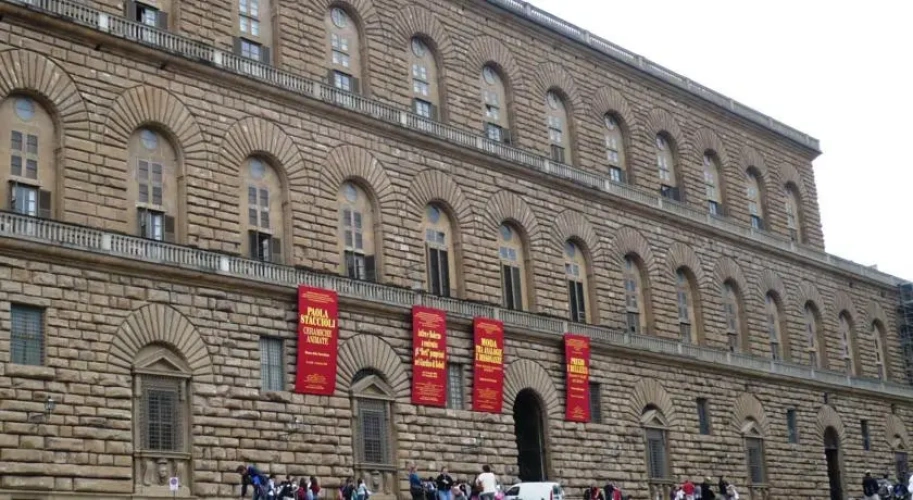
We stopped at the Chiesa di San Felice in Piazza before heading to Santo Spirito. It's close to the Pitti Palace, and though it's simple rather than grand or famous, this church is among the oldest in Florence and deserves a look if you're nearby. Admission is free. The interior has Gothic traces and dates back to 1066, while the facade is Renaissance in style and thought to be by Michelangelo, the architect and sculptor who designed the Medici Riccardi Palace. Inside, the altars hold valuable works: Starnina's Virgin Mary and Child (1413), Ridolfo del Ghirlandaio's Madonna and Angels (1520), and Bicci di Lorenzo's fresco of the Virgin with a Belt and Saints. With its plain exterior, historic interior and art, this nearly 1,000-year-old church is worth a brief visit.
There is a lot of art to see here, from a Crucifix from the second half of the 14th century by the Giotto school to work by Bicci di Lorenzo and Neri di Bicci, Rodolfo del Ghirlandaio, Empoli, Starnina, the Master of the Bargello, the Master of Signa, Giovanni da San Giovanni, and Volterrano. The church is one of Florence's oldest, with records reaching back to the 11th century. It stands in Oltrarno, just steps from Ponte Vecchio, Palazzo Pitti, the Basilica of Santo Spirito, and the Church of the Carmine. Over the centuries it passed through the Benedictines, Camaldolese, and Dominican nuns. Its biggest changes came in the 15th century, when Michelozzo created the Renaissance façade. That makes a fascinating contrast with the interior's 14th-century late Gothic style. A must-see if you're planning to explore the historic Oltrarno district and its neighborhoods.
Though it's small and somewhat overlooked, this intimate church is well worth a quick visit. Its original core dates back to the year 1000, and it was later expanded when the nearby Benedictine monastery was annexed. The facade we see today is attributed to Michelozzo or his school.
Explore attractions, restaurants and transport around the hotel
20 m 1 min walk
6.2 km
203 m 3 min walk
57 m 1 min walk
Important conditions for your stay